
How the Fentress County Court Calendar Works
Three sources look like calendars, yet each answers a different question. A case docket holds the setting entry for one case. It might be an arraignment, plea, trial, compliance review, or reset. The Eighth Judicial District Criminal Court calendar gives Fentress County its broader term structure. The state calendar comes from the Tennessee Administrative Office of the Courts. It lists events and oral arguments. Only the docket tells you when a local case is set. The county publishes no verified public online version of it.
Which office you call depends on the case. The Fentress County Circuit Court Clerk keeps Circuit, Criminal, General Sessions, and Juvenile records. Chancery litigation and probate sit with the Clerk and Master. A Jamestown ordinance or city traffic date belongs to the Jamestown City Court Clerk. Begin with the court name, not a broad county search. Each office controls its own settings.
Fentress County's Three Criminal Terms
Under the official Eighth Judicial District criminal rules, Fentress County Criminal Court terms open on the second Monday of January, May, and September. A term is simply a block of court business. It does not prove that any person must appear on that Monday. Dispositions, pretrial motions, bench trials, payment or compliance work, and other nonjury matters fill the first two days, and a nonjury arraignment day falls within each term as well. The remaining days hold jury trials.
That framework shapes how you read a clerk-confirmed date. It never replaces the latest setting order. A case may land on one day inside the term, get reset by a signed order, or follow a court-specific direction. The Eighth District criminal rules supply the term pattern, while the clerk's live case entry gives the current hearing date.
Fentress County Court Date Lookups
A full Fentress County court date lookup means using every channel at hand. The county posts no verified daily docket PDF. There is no public calendar terminal, no court-coordinator line, and no standing video-hearing link. Because of that gap, the clerk and the newest case paper carry the search. They are the reliable anchors.
- Read the latest notice, citation, bond paper, order, or judgment. Copy the full court name, case number, date, time, and location.
- Call the Circuit Court Clerk at 931-879-7919 for Circuit, Criminal, General Sessions, or Juvenile matters. Call the Clerk and Master at 931-879-8615 for Chancery or probate matters.
- For a Jamestown city citation, contact the City Court Clerk at 931-879-8815. A municipal payment page is not proof of the hearing date.
- Ask whether the entry is a hearing, arraignment, trial, compliance review, or term date, and whether a later reset order exists.
- Check county closure notices before a trip, then request the setting order or docket in writing if phone confirmation is not enough.
- Use state calendar and appellate tools only for their stated roles. Ask counsel about appearance directions in a represented case.
You can inspect records in person at the correct clerk's counter, subject to access rules. Written requests go by mail, email, or fax, though official pages promise no electronic delivery. Name the court, the full case style, the case number, the date range, and the exact setting record you want. Specific requests get faster answers.
Fentress County and the AOC Calendar
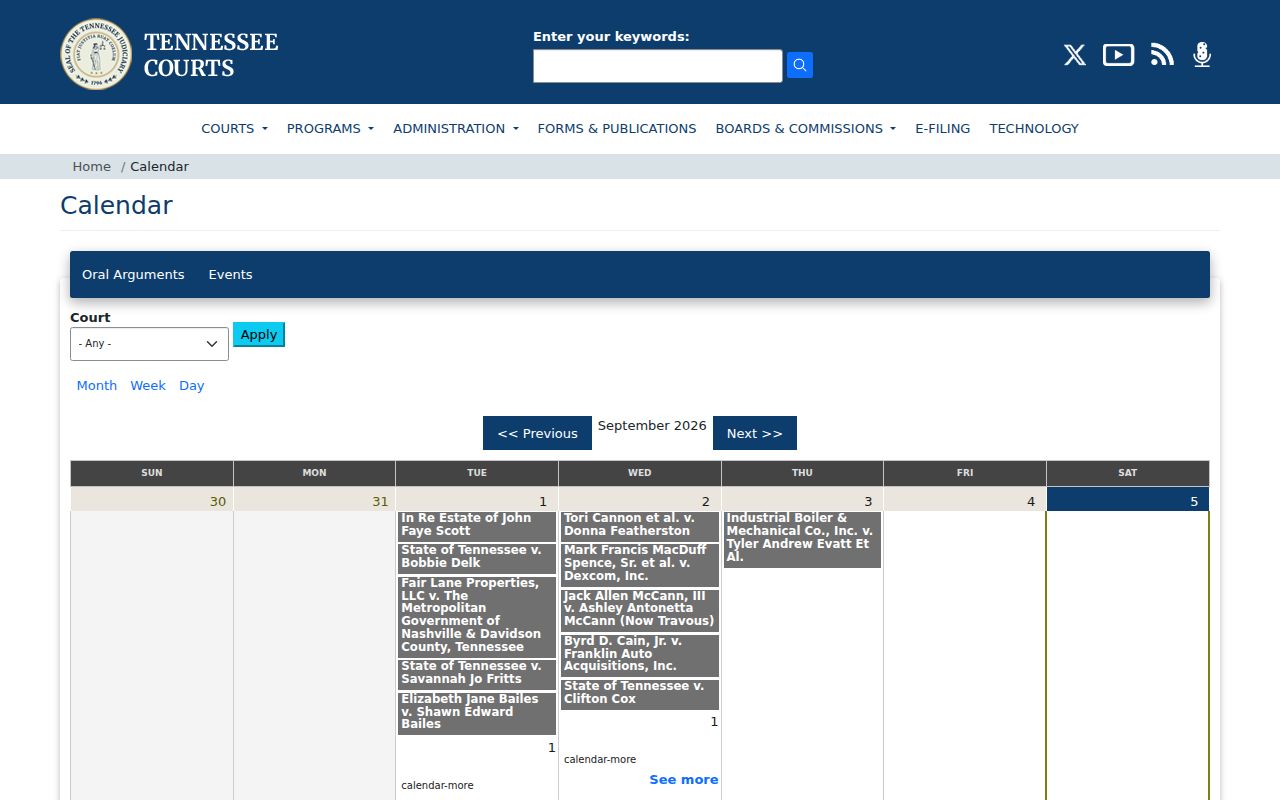
The Tennessee AOC calendar offers Events and Oral Arguments views, an Event Type selector, a Court selector, and Month, Week, and Day controls. It gives no Fentress County trial-setting selector. So treat a blank result with care. An empty state calendar never means a local hearing was canceled or that no local case exists.
The Tennessee Judiciary homepage routes visitors to calendars, court forms, self-help material, and public case resources. It is a solid start for state material, not a local docket display.
Court Settings: What Each Field Means
A copied setting works like a compact index entry. Keep enough detail to match it to the right case, court, and event. The listed time may be a docket-call or ready time for everyone. It is not a promise your case is heard at that minute. Confirm courtroom and judge details too. County and AOC sources give differing address references. One covers the Justice Center, the other the historic courthouse.
| Date | The scheduled day shown on the newest clerk entry or signed order. |
|---|---|
| Time | The appearance or ready time. Fentress criminal trial rules use 9:00 a.m., but individual orders still control. |
| Courtroom | The room and building for the event. Confirm it before travel. |
| Judge | The judicial officer or court division assigned to the setting. |
| Setting type | Arraignment, motion, plea, bench trial, jury trial, compliance review, or another stated event. |
| Result or reset | The outcome of the setting and any new date entered afterward. |
Keep the full case number and case style as well. Lay a clerk printout beside the newest signed order and compare. A calendar line can go stale, and an old date may linger after the case moves.
Fentress County's 9:00 Ready Rule
One Eighth District criminal rule makes parties ready for trial at 9:00 a.m. Felony matters take priority over misdemeanors. Incarcerated defendants come first. Those rules set courtroom order at a high level. They still do not say when an individual case gets called. Nor do they excuse anyone from a different time stated in a current order.
Term date is not case time. A Fentress County term calendar, a 9:00 a.m. ready rule, and a case-specific setting are three distinct pieces of information.
Ask the clerk to read back the date, time, court, location, and setting type. If you have a lawyer, ask counsel how docket-call practice applies to you. Never use the relative order of cases on an old calendar to guess your arrival time.
When a Court Date Moves
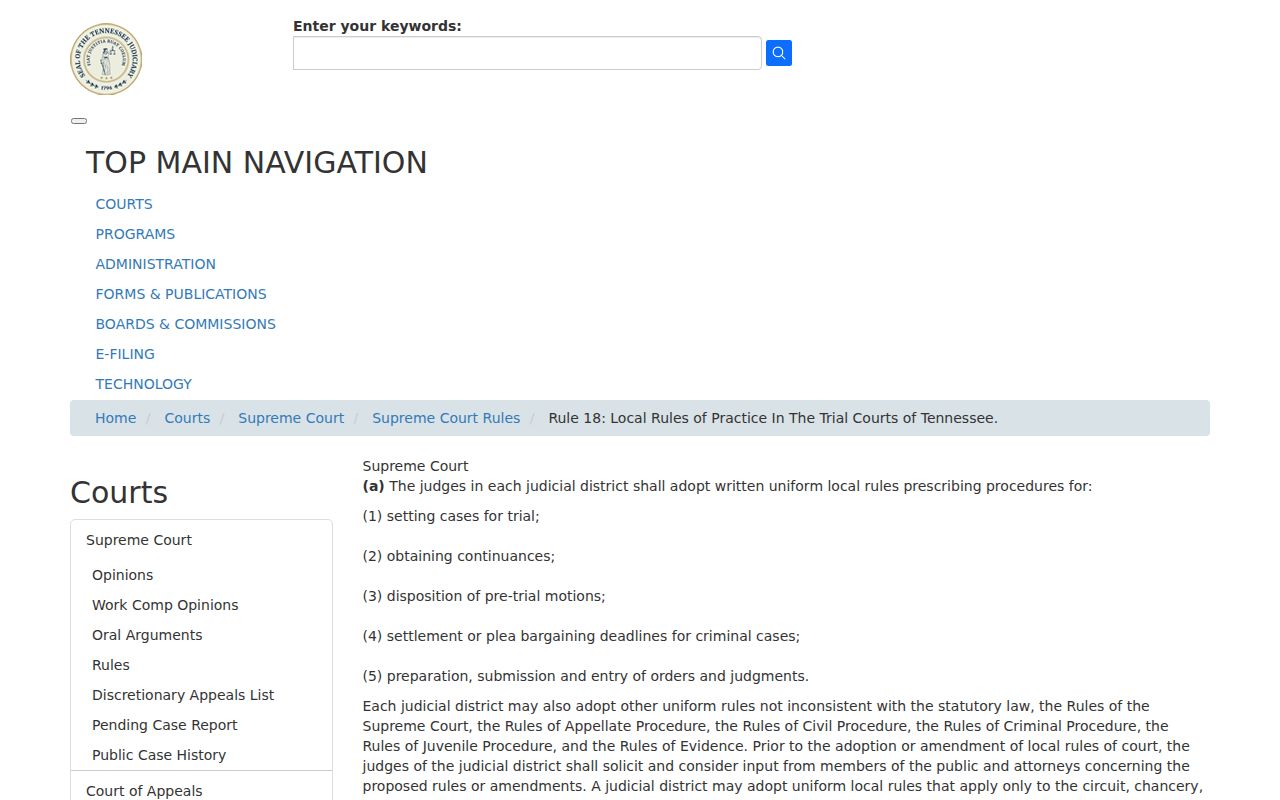
A proposed continuance is not the new court date. The Eighth District criminal rules demand a written motion backed by affidavits or documents. Agreement alone cannot make a continuance effective; written court approval is required. Tennessee Supreme Court Rule 18 also calls for local trial-court procedures. Those procedures cover settings, continuances, motions, deadlines, and orders. The official Rule 18 page shows the state framework behind those local scheduling rules.
Scan the entries for words like “reset,” “continued,” “pass,” or “new trial date.” Then match that entry with whatever date comes next. If two possible dates survive, phone the clerk. Keep the filing deadline and the hearing date straight; they answer different questions.
Fentress County Closure Notices
The Fentress County notices page lists government closures and public meetings. It will tell you whether an office's doors might be shut. It is not a court calendar, though. A closure notice alone never continues a hearing.
When a closure lands on your court date, call the clerk. Ask if the court entered a new setting. Then request the order or notice that records the change. Meeting notices sometimes point to the Historic Courthouse. But the court offices and records counters may sit at the Justice Center. Confirm both the date and the place before you go.
Fentress County Setting Terms
A calendar label tells you why a case was called. It does not tell you how it ended. Learn the local terms, and you can ask the Fentress County clerk a sharper question.
- Arraignment
- A formal plea appearance after indictment. A not-guilty plea may lead to a trial date.
- Motion hearing
- A setting for the court to consider a filed request before trial.
- Negotiated disposition
- A proposed plea or agreed resolution submitted for court action.
- Bench trial
- A trial decided by the judge rather than a jury.
- Compliance review
- An administrative check on payment or another court-ordered duty.
- Continuance
- A court-approved move from one date to a later date.
Need the full story past the setting itself? Use the Fentress County docket search routes and ask the clerk for the underlying order, judgment, or docket sheet.
Missed Settings and What Comes Next
Missed a setting? Act fast. Call the clerk for the court named on your paperwork, give the full case number, and ask what the docket now shows. If you have counsel, make that call promptly too. Local criminal rules say a defendant who has pleaded not guilty must show up on the trial date with no further notice. Skipping that date can bring bond or capias consequences where the rule applies.
Missed a setting? Do not assume the case was reset or dismissed because the scheduled day passed.
Contact the court-specific clerk and your lawyer at once, then obtain the newest setting entry or order.
A licensed Tennessee attorney can advise what action is appropriate for the particular case.
The Circuit Court Clerk keeps Circuit, Criminal, General Sessions, and Juvenile records. Chancery and probate files belong to the Clerk and Master. Jamestown municipal cases stay with the city clerk. When a phone call does not settle it, send a focused written request. Mail, email, fax, or the county records process all work. One ask beats a blanket demand. Request the current setting order, not every document in the file.